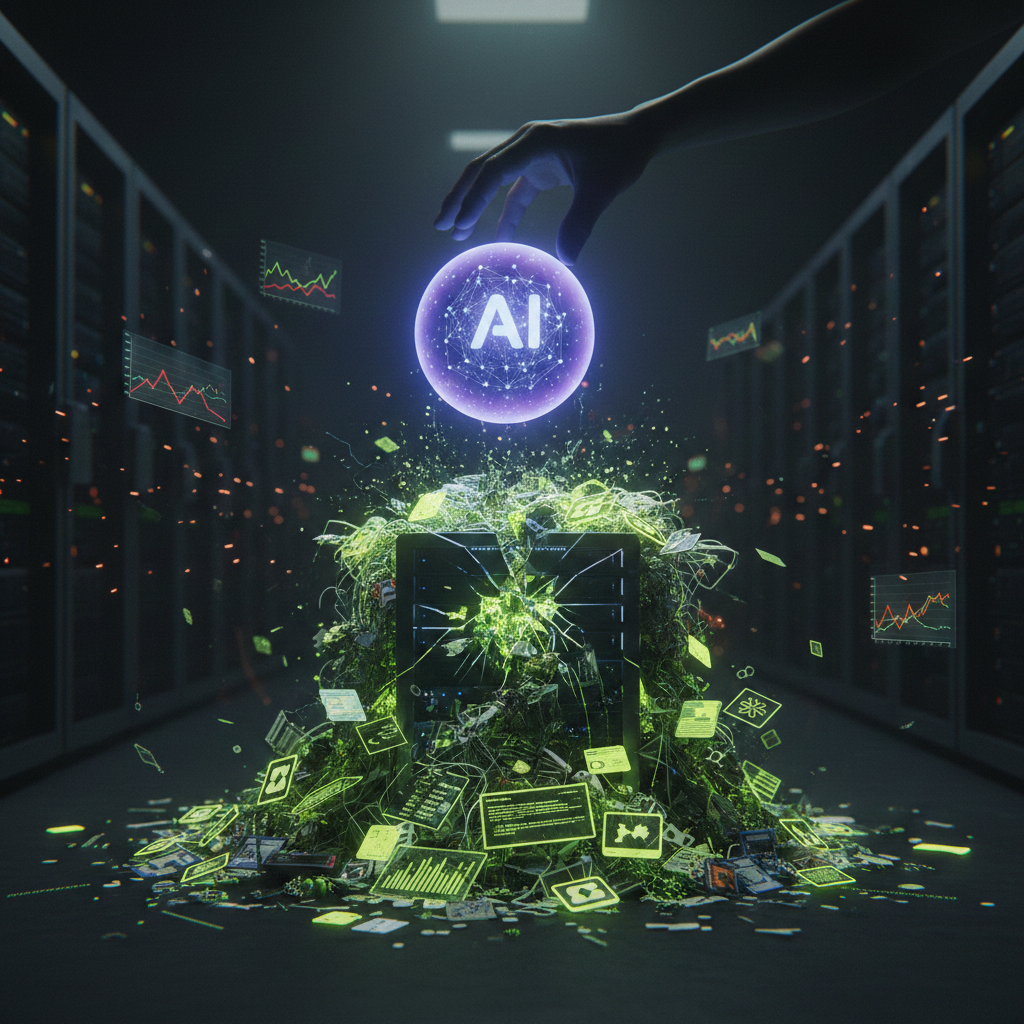
The $3,000 Instagram Post That Should Terrify Every CTO
A Fortune 500 brand just paid an influencer $3,000 for a sponsored post. The caption? AI-generated. The engagement? 0.3%. The comments? Bots talking to bots.
The influencer's team used ChatGPT to write the copy, DALL-E to touch up the image, and a third AI tool to schedule it. Total human involvement: 90 seconds. The brand's ROI: negative infinity.
This isn't a creator economy problem. This is your software problem.
Here's why: The same pressure to "ship AI fast" that's destroying trust in social media is the exact pressure driving executives to bolt AI features onto platforms that can barely handle their current load. I've seen it in rescue audits-companies spending $50K on an AI chatbot integration while their core API times out 20% of the time.
You don't have an AI adoption problem. You have a prioritization problem. And the creator economy is showing us exactly what happens when we get it wrong.
What "AI Slop" Actually Means (And Why It's Not About the AI)
"AI slop" is the internet's new term for mass-produced, low-effort AI content flooding platforms. Think:
- Stock photo captions that sound like a robot having a stroke
- Blog posts regurgitating the same SEO keywords 47 times
- YouTube videos with AI voiceovers reading Reddit threads
- LinkedIn thought leaders copying each other's AI-generated takes
But here's the part everyone misses: The problem isn't that AI generated the content. The problem is nobody gave a damn about quality control.
I ran a rescue audit last quarter for a SaaS company that added "AI-powered insights" to their dashboard. Users couldn't trust the insights. Not because the LLM was bad-it was GPT-4-but because the underlying data pipeline was a mess. Duplicates, null values, inconsistent schemas. The AI was like a Michelin-star chef cooking with rotten ingredients.
Their engineering team knew the data was broken. Management knew users complained about accuracy. But the board wanted "AI features" in the next funding deck, so they shipped it anyway.
That's AI slop.
It's not a content problem. It's a governance problem. It's what happens when you optimize for optics over outcomes.
The Three Ways Companies Create AI Slop (Without Realizing It)
1. The "Wrap It in AI" Tax
This is the most common failure pattern we see in rescue engagements.
A company has a slow, buggy web app. Users complain. Engineering suggests refactoring the core services-6 weeks of work. Management says, "What if we just add an AI assistant to help users navigate the bugs?"
Now you have:
- The original bugs
- An AI that hallucinates solutions to those bugs
- Users who trust the platform even less
- 6 weeks of engineering debt you still haven't paid
We see this constantly with legacy systems. A logistics platform we audited had bolted a "smart routing" AI onto a database that couldn't handle concurrent writes. The AI would suggest routes, the system would fail to update them, and drivers would show up at the wrong warehouse.
The fix? Not better AI. They needed to stabilize their write transactions first. Basic database indexing and connection pooling. The AI came later-and when it did, it actually worked.
2. The "Fast Follow" Panic
Your competitor announces an AI feature. Your CEO sees the press release. You get a Slack message: "Can we do this by EOQ?"
I call this the Fast Follow Panic. It's how you end up with:
- AI features nobody asked for
- Zero integration with existing workflows
- A product roadmap that's just a mirror of competitors
- Engineering teams working weekends on features that will be deprecated in 6 months
A fintech client came to us after their "AI financial advisor" launched to 0.4% adoption. Why? Because it lived in a separate tab, required manual data entry (despite having access to transaction data), and gave generic advice you could get from any blog.
They'd rushed to match a competitor's announcement. They didn't stop to ask: "What problem does this solve that our existing analytics don't?"
The real opportunity? Their transaction categorization was garbage. Users manually recategorized 30% of transactions. An AI that fixed that would've been transformative. But it wasn't flashy enough for the press release.
3. The "AI Will Fix Our Process" Delusion
This one hurts because it comes from a good place.
A marketing team is slow. Takes 3 weeks to produce a blog post. Management thinks: "Let's use AI to speed up content creation!"
They buy an AI writing tool. Now they produce 10 blog posts a week. Quality drops. Engagement craters. SEO rankings fall because Google's algorithms detect low-effort content.
The problem was never writing speed. It was approval workflows, unclear strategy, and 6 stakeholders needing sign-off. The AI just let them create more crap, faster.
We audited a B2B platform that added "AI-generated product descriptions" to their catalog. Conversion dropped 12%. Why? The AI descriptions were technically accurate but missed the emotional hooks that sales teams had spent years refining.
They'd automated the wrong part. The bottleneck wasn't writing-it was photography and data entry. AI could've helped there. Instead, they automated the one thing that was already working.
What the Creator Economy Crisis Teaches Engineering Teams
The creator economy is collapsing under AI slop because platforms optimized for volume over value. YouTube's algorithm rewards upload frequency. Instagram's rewards posting consistency. TikTok's rewards trend-chasing.
Creators who use AI to pump out content win the algorithm. But they lose the audience.
Sound familiar? It's the same dynamic in product development:
- Volume metrics (features shipped, velocity points, commits) get rewarded
- Value metrics (user retention, NPS, bug-free releases) get ignored
- Teams optimize for the metric that's easier to game
- Quality collapses
Here's what we learn from watching creators fail:
Trust Is Brittle, Scale Amplifies Breaks
A creator with 100K followers can lose 30% of them in a week if they start posting AI slop. The scale that made them successful amplifies their failure.
Same with software. A company that ships a half-baked AI feature to 10K users will see churn. Ship it to 100K users and you'll see a PR crisis.
We rescued a PropTech platform that had rolled out an "AI property valuation" feature to their entire user base. It was trained on 6 months of data. When the market shifted, it started giving valuations 20% off. Real estate agents started warning clients not to trust the platform.
They should've:
- Tested with 5% of users
- Added confidence intervals to valuations
- Let users report bad estimates
- Retrained weekly, not quarterly
Instead, they shipped fast to everyone. Fixing the trust deficit took 9 months.
Authenticity Can't Be Automated (But Accuracy Can)
Creators are learning that audiences value authenticity more than polish. A grainy iPhone video with genuine insight beats a 4K AI-generated explainer.
In software, the analog is: Users value accuracy more than intelligence.
Nobody cares if your AI "sounds smart" if it gives them wrong answers. I'd rather have a simple rules engine that's 99% accurate than an LLM that's 85% accurate but uses fancier language.
A healthcare client wanted to add "AI symptom checking" to their patient portal. We pushed them toward a structured decision tree based on clinical guidelines instead. Less sexy. Way more accurate. Medically defensible.
The AI came later-to parse patient descriptions into structured inputs for the decision tree. Best of both worlds.
Feedback Loops Need to Be Faster Than Failure Modes
Creators who catch AI slop early can pivot. Those who don't notice until their engagement tanks are screwed.
Your monitoring needs to be faster than your failure modes. If AI can hallucinate customer-facing content, you need real-time human review or automated quality gates.
We set up a rescue for a legal tech platform where the AI would occasionally reference cases that didn't exist. Their QA process? Manual review once a week.
We implemented:
- Automated citation verification (checks case numbers against legal databases)
- Confidence scoring (low confidence triggers human review)
- User feedback loops (lawyers can flag bad citations immediately)
The AI still hallucinates sometimes. But now it gets caught in seconds, not days.
The BBB Formula: Stabilize First, Improve Second, Add AI Last
This is where most companies get it backwards. They see AI as the solution to their performance problems.
"Our checkout flow has a 40% drop-off rate. Let's add an AI assistant to help users!"
No. Fix your checkout flow first. Then add AI if it still makes sense.
Stabilize First:
- Fix critical bugs
- Optimize slow queries
- Improve error handling
- Clean up your data
Improve Second:
- Streamline workflows
- Remove unnecessary steps
- Better UX on core paths
- Address user feedback
Add AI Last:
- Identify repetitive tasks AI can handle
- Build on stable foundations
- Implement with quality gates
- Monitor obsessively
We've run this playbook in dozens of rescues. It works because AI multiplies whatever you feed it. Feed it chaos, get amplified chaos. Feed it stability, get amplified value.
A marketplace client came to us with slow search, buggy payments, and a CEO who wanted "AI-powered recommendations."
We ignored the AI request for 8 weeks. We:
- Fixed their Elasticsearch config (search went from 2s to 200ms)
- Debugged their Stripe webhook handlers (payments stopped failing)
- Cleaned up their product taxonomy (20% of listings were miscategorized)
Then we added AI recommendations. They worked beautifully-because the underlying data was clean and the system could handle the load.
ROI on the AI: 15% increase in average order value. ROI on the infrastructure fixes: 35% reduction in support tickets.
Guess which one the CEO wanted to talk about in the board deck? Both. Because we did them in the right order.
How to Audit Your Platform for AI Slop Risk
If you're planning to add AI features, run this checklist first:
Data Quality Check
- What's your data accuracy rate?
- When was the last time you audited for duplicates/nulls/inconsistencies?
- Can you trust this data to make automated decisions?
Red flag: If you wouldn't make a business decision based on this data manually, don't let AI make it automatically.
System Stability Check
- What's your current error rate?
- How often do deployments cause incidents?
- Can your infrastructure handle 2x the current load?
Red flag: If your system is already flaky, adding AI will make it flakier. We've seen AI features take down entire platforms because they triggered cascading failures in unstable services.
User Trust Check
- What's your NPS?
- How many support tickets are "I don't trust this feature"?
- Do users understand what your AI does?
Red flag: If users already don't trust your platform, AI won't fix that. It'll make it worse.
Team Readiness Check
- Can your team explain how the AI works?
- Do you have monitoring for AI-specific failures?
- Is there a rollback plan?
Red flag: If you can't explain it, you can't debug it. And you will need to debug it.
What Good AI Integration Actually Looks Like
Let me show you a real example from one of our AI Product Launch Sprints.
Client: B2B scheduling platform Problem: Sales teams spent 2 hours/day manually scheduling demos across timezones Bad AI Solution: "Let the AI schedule everything automatically!" What We Built:
- Stabilization Phase (Week 1-2):
- Fixed calendar sync bugs (Google/Outlook)
- Cleaned up timezone handling
- Improved availability rules
- Improvement Phase (Week 3-4):
- Streamlined booking flow (7 steps → 3 steps)
- Added smart defaults based on historical data
- Built bulk reschedule feature
- AI Phase (Week 5-8):
- AI suggests optimal meeting times based on conversion data
- Natural language parsing for scheduling requests
- Automated follow-up sequences
Result? 85% reduction in scheduling time. But here's what matters: Only 30% of that came from AI. The other 70% came from fixing the underlying system.
The AI worked because it had clean data, stable integrations, and clear boundaries. It suggested. Humans decided. Perfect division of labor.
Your Move
The creator economy's AI slop crisis is a warning. It's what happens when you optimize for speed over stability, volume over value, optics over outcomes.
Your platform is one bad AI feature away from the same fate.
So ask yourself:
- Are you adding AI to solve real problems or to match competitors?
- Can your infrastructure handle what you're about to build?
- Will this AI make your product better or just more complex?
If you can't answer those questions with confidence, you don't need AI. You need a rescue.
Skip that middle step. Let's build it right the first time.
Book a Free Rescue Call